


Why do coral reefs matter?
Not only are these ecosystems rich in colours and diverse shapes – almost like an underwater city – they provide immense ecosystem services, not only for us humans, but for marine life itself. Despite covering only ~0.1% of the seafloor, they support up to 25% of marine life (Hoegh-Guldberg et al., 2017). Now, this does not mean that 25% of marine species permanently live within these ecosystems, but rather that reefs play an important role in one or more phases of their life cycles.
Similar to rainforests, coral reefs provide habitats, shelter, nurseries, breeding grounds and migration pathways that support a wide range of marine organisms (Bellwood et al., 2006). In Koh Tao alone we can observe this on almost every dive, if you’ve been paying attention. From groupers camouflaging against different reef structures, to damselfish using branching corals as their private homes (Image 1), coral reefs are extremely important for life in the ocean.

A classic example of this relevance comes with several species of sea turtles, including green and hawksbill turtles (also locals in Koh Tao, if you know where to look). Both of these species feed primarily on seagrass and algae, which thrive in the shallow waters that surround or grow alongside coral reefs, helping maintain balanced algal communities (Sanchez et al., 2024). Moreover, as thousands of sea turtles hatch on tropical beaches, they face a truly dangerous swim in search for reef ecosystems, where they can find shelter and protection from predators and rough ocean conditions.
What’s more, coral reefs provide immense ecosystem services for coastal communities, with approximately 29% of the global population living within 50 kilometres of the coast. Some of these services include coastal protection (by mitigating wave action before it reaches shore), supporting fisheries and tourism, and sustaining coastal economies (Kittinger et al., 2012). While reefs do play a role in ocean carbon cycling, their most significant climate-related service is shoreline protection and ecosystem stability rather than large-scale carbon storage.
Coral reef structures
To understand why coral reefs are so vulnerable to human activities, we must first understand their physiology. Corals are cousins of jellyfish, belonging to the same phylum, Cnidaria. They share similar characteristics such as stinging cells (nematocysts) and radial symmetry. However, reef-building corals exist in a polyp form, rather than the free-swimming medusa form we primarily observe in jellyfish.
Coral reefs — more specifically, the skeleton beneath the living tissue — are made of limestone (calcium carbonate). The coral polyp builds this skeleton by continuously depositing calcium carbonate beneath itself (Figure 1), allowing it to grow upward and outward. Thus, the skeleton thickens and expands throughout its life, with growth rates varying from species to species.
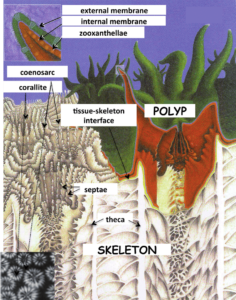
The lifespan of individual coral polyps is relatively short, as they are periodically replaced within a colony. However, the colony itself can live much longer. Massive corals such as Porites can live for several centuries, and some reef systems preserve growth records spanning hundreds to thousands of years (Gischler et al., 2023). When a colony dies, its skeleton remains as part of the reef framework, becoming a perfect substrate for new coral larvae to settle and begin their own growth. This is how massive reef systems such as the Great Barrier Reef are formed: layer upon layer of coral growth accumulating over centuries.
Reef-building corals have another peculiarity: they maintain a symbiotic relationship with microscopic algae known as zooxanthellae. Although coral polyps can capture prey with their tentacles, up to 90% of their energy can come from these symbiotic algae (Hughes et al., 2017). The algae photosynthesise and provide nutrients to their host, receiving shelter and access to sunlight in return. Moreover, corals host a wide range of beneficial bacteria (much like we do), which contribute to nutrient cycling and overall health.
Effects of climate change on coral reefs
The problem arises when sea surface temperatures increase. Elevated temperatures damage the photosynthetic machinery of the zooxanthellae, leading to the production of harmful reactive oxygen species. This causes stress to the coral host, which then expels its symbiotic algae (Middlebrook et al., 2010). Without the algae, the coral loses both its main energy source and its vibrant colours. This phenomenon is known as coral bleaching (Image 2).
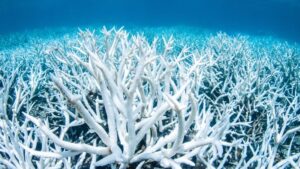
Corals can recover from bleaching if stressful conditions are short-lived. They may temporarily rely more on heterotrophic feeding, and if temperatures return to normal, they can reacquire symbiotic algae and regain their colour., although they would be more supseptible to desiase outbreaks (Sully et al., 2019). However, if high temperatures persist — as observed during marine heatwaves — coral polyps may die of starvation. Due to the increasing frequency and intensity of these heatwaves, driven by global warming, corals often do not have sufficient time to recover, and the equilibrium of reef ecosystems becomes severely disrupted.
Ocean acidification is another challenge these ecosystems face due to increasing levels of CO₂ being released into the atmosphere through the burning of fossil fuels. The oceans, much like forests, act as major carbon sinks, absorbing approximately 25–30% of the carbon dioxide (CO₂) emissions produced by human activities each year. As the ocean absorbs higher levels of atmospheric CO₂, seawater pH decreases (Andersson and Gledhill, 2013). This reduces the availability of carbonate ions, which are essential for corals to build their calcium carbonate skeletons. As a result, coral skeletons can become weaker and more brittle, making reef structures less resilient to damage. Ultimately, these structures may cease to exist, along with the ecosystem services they provide.
Despite their tough appearance, corals are highly vulnerable to anthropogenic impacts. Coral reefs are far more than colourful dive sites; they are living, breathing ecosystems built slowly over centuries, supporting an extraordinary web of marine life while quietly protecting coastlines and sustaining human communities. Yet their survival depends on a delicate biological balance that is increasingly disrupted by rising ocean temperatures and human pressures. Understanding how reefs function — from the tiny coral polyp depositing calcium carbonate to the intricate partnership with zooxanthellae — allows us to better appreciate both their resilience and their fragility. If we are to ensure that future generations can continue to witness these underwater cities thriving, protecting coral reefs is no longer optional — it is essential.
Author: Isabel Vizcaya
Reference list:
Andersson, A.J. and Gledhill, D., 2013. Ocean acidification and coral reefs: effects on breakdown, dissolution, and net ecosystem calcification. Annual review of marine science, 5(1), pp.321-348.
Bellwood, D.R., Wainwright, P.C., Fulton, C.J. and Hoey, A.S., 2006. Functional versatility supports coral reef biodiversity. Proceedings of the Royal Society B: Biological Sciences, 273(1582), pp.101-107.
Gischler, E., Hudson, J.H., Eisenhauer, A., Parang, S. and Deveaux, M., 2023. 9000 years of change in coral community structure and accretion in Belize reefs, western Atlantic. Scientific Reports, 13(1), p.11349.
Hoegh-Guldberg, O., Poloczanska, E.S., Skirving, W. and Dove, S. (2017) ‘Coral Reef Ecosystems under Climate Change and Ocean Acidification’, Frontiers in Marine Science, 4.
Hughes, T.P., Barnes, M.L., Bellwood, D.R., Cinner, J.E., Cumming, G.S., Jackson, J.B., Kleypas, J., Van De Leemput, I.A., Lough, J.M., Morrison, T.H. and Palumbi, S.R., 2017. Coral reefs in the Anthropocene. Nature, 546(7656), pp.82-90.
Juillet-Leclerc, A., 2020. Could coral skeleton oxygen isotopic fractionation be controlled by biology. Isotopes Applications in Earth Sciences.
Kittinger, J.N., Finkbeiner, E.M., Glazier, E.W. and Crowder, L.B. (2012) ‘Human Dimensions of Coral Reef Social-Ecological Systems’, Ecology and Society, 17(4), p. art17.
Middlebrook, R., Anthony, K.R.N., Hoegh-Guldberg, O. and Dove, S. (2010) ‘Heating rate and symbiont productivity are key factors determining thermal stress in the reef-building coral Acropora formosa’, Journal of Experimental Biology, 213(7), pp. 1026–1034.
Sanchez, C.L., Casale, P., Bunbury, N., A’Bear, L., Banane, V., Benstrong, F., Bielsa, M., Jones, C.W., Koester, A., Murasko, S. and van Rooyen, M.C., 2024. Fine-scale foraging ecology and habitat use of sympatric green and hawksbill turtles in the Western Indian ocean. Marine Environmental Research, 198, p.106529.