Big Blue Conservation, the Eco arm of Big Blue Diving on Koh Tao, was recently honored with the job of introducing a Marine Conservation curriculum to the pupils at the International School of Samui. The team from Big Blue Conservation comprises of two Marine Biologists Jade Getliff & Ciara Hunt who have designed a comprehensive, age-appropriate curriculum for every year throughout the school starting from Year 1, ending 2 weeks later with Year 13.
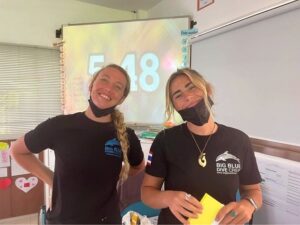
Marine Biologists and Scuba Instructors Jade (right) and Ciara (left).
The curriculum, as you are about to read, covers all aspects of the marine world from identifying marine vertebrates and coral and the ecological niche they fill to the impacts imposed upon their habitats from anthropogenic activity, global warming, pollution, and other concerns that impact our futures and what we can do about it.
With three sets of personal dive equipment, (as Jim Donaldson, the owner of Big Blue Diving and a parent at the school, wanted to tag along as well!), six sets of scuba equipment, a few small scuba tanks, and a whole bunch of spare masks fins and snorkels, the Big Blue Conservation Team arrived at the International School of Samui to teach our first day of our Marine Conservation Program to the ever so wonderfully spritely Year 1.
Day one – Years one and two.
Owner of Big Blue Diving, Jim showing year one students how to draw their favourite marine critters.
On day one, we stepped into the classroom to be greeted by the very welcoming Teacher Rachel and a group of kids who seemed to be as excited by the fact Jim had no hair as they were that there were two visiting marine biologists in the classroom with them today.
Our intent for our morning session with Year 1 was to ignite a few sparks of interest with some interesting video of footage of fish local to Thailand and recognize the variety of different species of marine creatures that live in the ocean as well as those that don’t and thereby understand what environments animals need to survive and the adaptations that allow marine creatures to thrive underwater. We played marine life bingo and drew some pictures of our favorite underwater animals in healthy marine environments and unhealthy marine environments. After a morning of supreme hyperactivity, the eco team had completed our first-year group of the program.
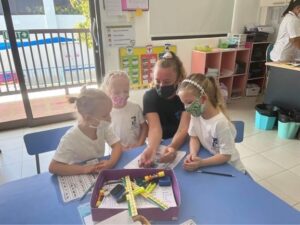
Marine Biologist Ciara helping the students create their underwater sea scapes.
Upon entering the year two classroom after lunch, we recognized an immediate difference in that one-year age group gap. For these six and seven years olds, we stepped up the tasks a little and felt we could introduce grouping marine animals by taxonomic group through recognizing the variety of body shapes of sea life and understanding how adaptations are linked to habitat. With photos, videos, and pictures to inspire them, the kids knuckled down to creating a picture differentiating a healthy marine environment from an unhealthy one, including all of the core marine taxonomic groups previously discussed.
We all finished the day enthused and inspired by the energy and contributions the students in years one and two gave to the program, both in the classroom and out of it.
Year two students proudly showing off their Turtle Badge certificates, awarded for completing their day of the Marine Conservation Program.
Day two – Year Three.
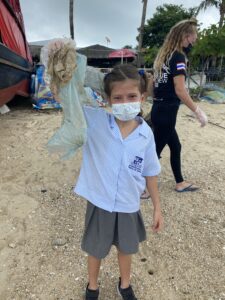
Year 3 students showing the camera all of the plastic bags she found after only two minutes during our beach clean at Bangrak.
The weather forecast wasn’t great for day two of the Marine Conservation program, the day on which we had planned to be outside for the majority of our activities with year three, so with trepidation, our Marine Biologists headed into school to be greeted by the very lovely Teacher Katie and her class of incredibly well behaved seven and eight-year-olds.
The plan for the morning was to bring about an awareness of the origins of plastic and how it can affect marine life, and then create a poster to show the different ways people can get involved in helping to clean up our oceans. The students were prompted to think about what can and can’t be recycled or reused and how sea creatures could be affected by plastics. The class teamed up in their groups and selected sea creatures, they then made a poster to show how plastic affects that animal and how people can help reduce the plastic in the ocean. They then presented their hard work to the class.
The most interesting find of the day… an action man leg!
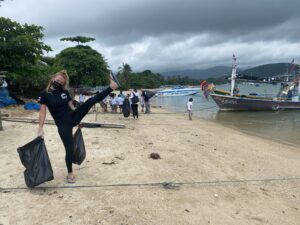
After the morning break, we checked the weather and decided to head out to the beach – Bangrak Beach, Seatran pier. This beach is probably the filthiest local beach to the school on the island and so, in our convoy of 4 mini-buses off we set off on a beach clean. After slipping on a pair of gloves and designating each bus group with their teacher off we trotted only 100 meters down the beach collecting as much rubbish as we could find. Then we went through our bags of rubbish & separated things like plastic bottles from polystyrene, and aluminum cans from discarded clothing, and miscellaneous bits of plastic from fragments of drift nets. The haul was astounding with the whole of Year 3 collecting almost 50 kilos of trash altogether.
Our afternoon was to be in the pool. So far weather-wise we’d been lucky but the clouds were getting darker and we were definitely in for a spot of rain… but like true mini marine biologists, our year three students gathered with us at the pool with their fins and masks & snorkels ready to be taught how to equalize, duck dive and how to clear a snorkel. We, however, didn’t get too far before an electrical storm passed over Samui and we were sensibly cleared from any further swimming pool activity. As much as this was a little disappointing for everyone, we are happy that some of the class were able to give it a go.
The storm marked the end of another great day where the students were awesome, showing heaps of initiative and excitement. We know they were shocked and surprised at some of the information they discovered today but hopefully encouraged by solutions we can activate in our everyday lives that will collectively benefit the healthy future of our oceans.
Towards the end of our beach clean, the clouds started to loom over Bangrak.
Day three – Year four.
A whole colony of edible polyp creations.
Today was all about corals! The objective was to answer the question: ‘Is coral a plant, an animal, or something else?’. Our expert marine biologists introduced words like polyp, calcium, tentacles, habitat, plankton, & zooxanthellae into an 8-year-old’s vocabulary as well as associating words like mouth, skeleton, oxygen, and carbon with a coral polyp. Conservation Department Manager Jade came up with a great idea for every person in the class to create their own coral polyp with the use of bananas, cookies, sherbert & pocky sticks and of course having built their coral marvel to then devour it as quickly and cleanly as possible, like fish!
We had a great morning with the 8 and 9-year-olds, and an exciting afternoon to look forward to as
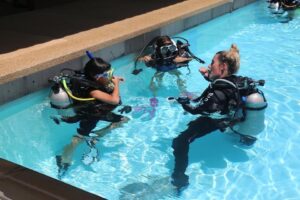
Jade & Ciara got themselves ready by the pool to take 16 students for their very first experience breathing underwater. We teamed our Year 4 divers into buddy teams of two and showed them how to equalize, how to clear a mask, how to clear a snorkel & regulator, and how to swim underwater. And like little merpeople, our Year 4s showed us what we already know as professional scuba divers… there’s nothing better than teaching people how to dive and introducing them to a whole new underwater world.
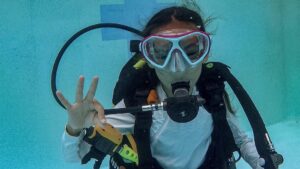
Excellent demonstration of the scuba sign for ‘okay!’
Day four – Year five.
When were introduced to Teacher Minnie on Thursday for Day 4 of our ISS/ Big Blue Marine Conservation Program, we were told that today’s class was smaller than we had had so far so we were very pleased to see how many of these 9 and 10-year-olds had signed up to come diving with us again in the afternoon.
The students tracking their chosen shark in real time.Marine Biologist Jade demonstrating the ocean currents practical.
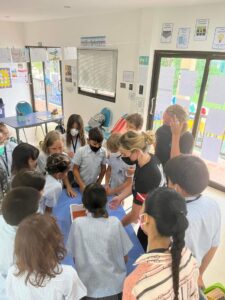
Our aim today was to identify the five main oceans and the different ecosystems within them and to discover how currents form. As a class, we discussed the different varieties of animals that depend on certain conditions in their ecological niche, how they may need to travel to find ideal feeding and breeding conditions, and how humans might impact their survival. We talked about how currents form and created our own ocean currents in a classroom practical. Food dye was added to boiling water, and ice-cool water then each was poured into their very own ocean-in-a-tray. The students were able to see the results for themselves as the warmer red water swirled around the slower colder blue water. Once the students had a firm grasp on ocean current theory, we went online and started tracking marine megafauna such as whales, sharks, and turtles in real time, that travel the open oceans and ride the currents. The students used this information and their newfound knowledge of currents to create a fact file on a real marine animal, how they migrate around the globe and why. In their groups, the kids presented their findings to the class.
One group presenting their work to the class.Jade with her instructor hat on, briefing the students on scuba skills they were to complete in the pool.
With red and green stained hands our Marine Biologists and Scuba Instructors set up for another afternoon of scuba diving in the pool. Owner Jim was pleasantly surprised to see how many kids have already scuba-dived before and how excited they were to be able to do it again at their school pool and with their friends. We let those who have dived before jump in with their buddy and team up with either Jade or Ciara while Jim briefed those in line next on the skills these budding divers would need to know, comprising of being able to clear the air space in their ears and sinuses by equalizing as well as the air spaces in the equipment like their snorkel, mask & regulator by exhaling through their nose or mouth upon direction. Like complete naturals, our scuba divers in Year 5 cruised through the afternoon! Well done Year 5. See you on Koh Tao for your 3-day SSI Junior Open Water Course!
Day five – Year Six.
For Big Blue Ding owner Jim, the final day of the junior school program was always going to be the highlight. His daughter, Lulu, studies at the school and is now in year six. Here is what Jim has to say about year six’s day with Big Blue Conservation:
In our ecosystems game, one of us had to be the shark..!
“I was way more excited than Lulu was. To sit in her classroom, to watch her interaction with her classmates, and put names to the faces of her peers. So I was a little caught off when I realized how nervous I suddenly was as I stepped into her classroom and introduced myself and Jade & Ciara to the class. This was the biggest group we had had so far in our ISS/ Big Blue Diving Marine Conservation Program and I suddenly realized how much older my little girl is than I have her in my mind. But battling through my emotions and with Teacher Nick to hold me for emotional support, our conservation team set off on our task for the morning which was to look at the struggles and threats our marine life are faced with every day which occur as a result of human activity and how we can react to stop, oppose or reduce these problems now and in the future. Together we identified the main threats to marine life being overfishing and bycatch, plastics and pollution, global warming and climate change and the impact these have on particular ecosystems. To demonstrate further we attempted an outside exercise in the playground whereby a habitat comprising of a kelp forest, sea urchins, otters, seals, and sharks is affected if one of those species is removed from that particular ecosystem. After a very sweaty 20 minutes or so of running around in the mid-morning sun, I was relieved to come back to the cool embrace of the air-conditioned Year 6 classroom. We spent the rest of the morning in groups designing an infographic based on a main threat to the ecosystems that the class had identified earlier and that each group felt most passionate about, and then presented it to the class. We were very impressed with how involved everyone became as they researched statistics online, created eye-catching visuals and impactful facts to grab one’s attention.“
Instructor Ciara with two students, who just breathed underwater for the first time.
The Year 6 students were great this morning. But how were they going to fare in the pool as we took a lot of them for their very first experience breathing underwater? Again, the students were excellent in the water. We were able to give everyone in the class an experience of scuba diving up and down the pool and, although it wasn’t maybe as much time as everybody would have liked to have, due to the demand to try diving, we think it went down a storm. The kids were all naturals and seemed to be super happy to have been given the opportunity.”
Year 6 loved their Marine Conservation Day as well as their try scuba session, and for us, it was the perfect way to end an awesome experience at the junior school of ISS. Next week we move onto the secondary school and are very much looking forward to really getting into the potential career opportunities there are to be had as we learn to protect our oceans.
Share
1 Comments on International School Program – Week One in the Junior School









iuhdsf oiuyebrg oew