


Predators in the reef
Corals, just like other animals, can face death by predation from other organisms. These organisms are known as corallivores, and are mainly composed of echinoderms (sea urchins, starfish), gastropods (snails), and some species of fish such as butterflyfish and parrotfish. They feed on several components of the coral colony: the individual polyps, their tissue, and their mucus. Interestingly, additional reef inhabitants can indirectly damage the reef throught different feeding behaviour. For example, damselfish act as reef gardeners by clearing patches of coral to encourage algal growth, which they subsequently graze on. Similarly, Titan triggerfish use their strong teeth to break apart coral structures, exposing prey hidden within the reef.

This feeding behaviours can cause minor to severe damage within reef ecosystems. Under normal environmental conditions, corals can bounce back and restore their tissues, as corallivore organisms are kept in check by predators higher up in the food chain—ultimately giving corals a chance to recover to full health.
However, when these predators outbreak (or when their numbers increase rapidly), they can significantly diminish coral cover and pose a great threat to reef ecosystems. This can deteriorate coral health further, as corals already face rapid declines linked to climate change, pollution, and destructive fishing practices. These outbreaks can lead to devastating ecological phenomena, as they facilitate the spread of diseases across colonies by creating pathogen entry points through feeding scars—a pattern notably observed in gastropod corallivore outbreaks (Montano et al., 2022). On the other hand, Crown of Thorns Starfish have reduced coral cover by up to 80% in some areas since the 1980s (Pratchett et al., 2017). This massive coral mortality has a detrimental effect, reducing reef complexity, biodiversity, and habitat availability for other marine organisms. This is without even accounting for their importance to human populations, as reefs are essential habitats that provide significant ecological, cultural, and economic value.
Two predators whose outbreaks can lead to these devastating ecological phenomena are found in the Indo-Pacific region: the Crown of Thorns Starfish (Acanthaster planci) and Drupella spp snails.
Drupella spp.
Overview
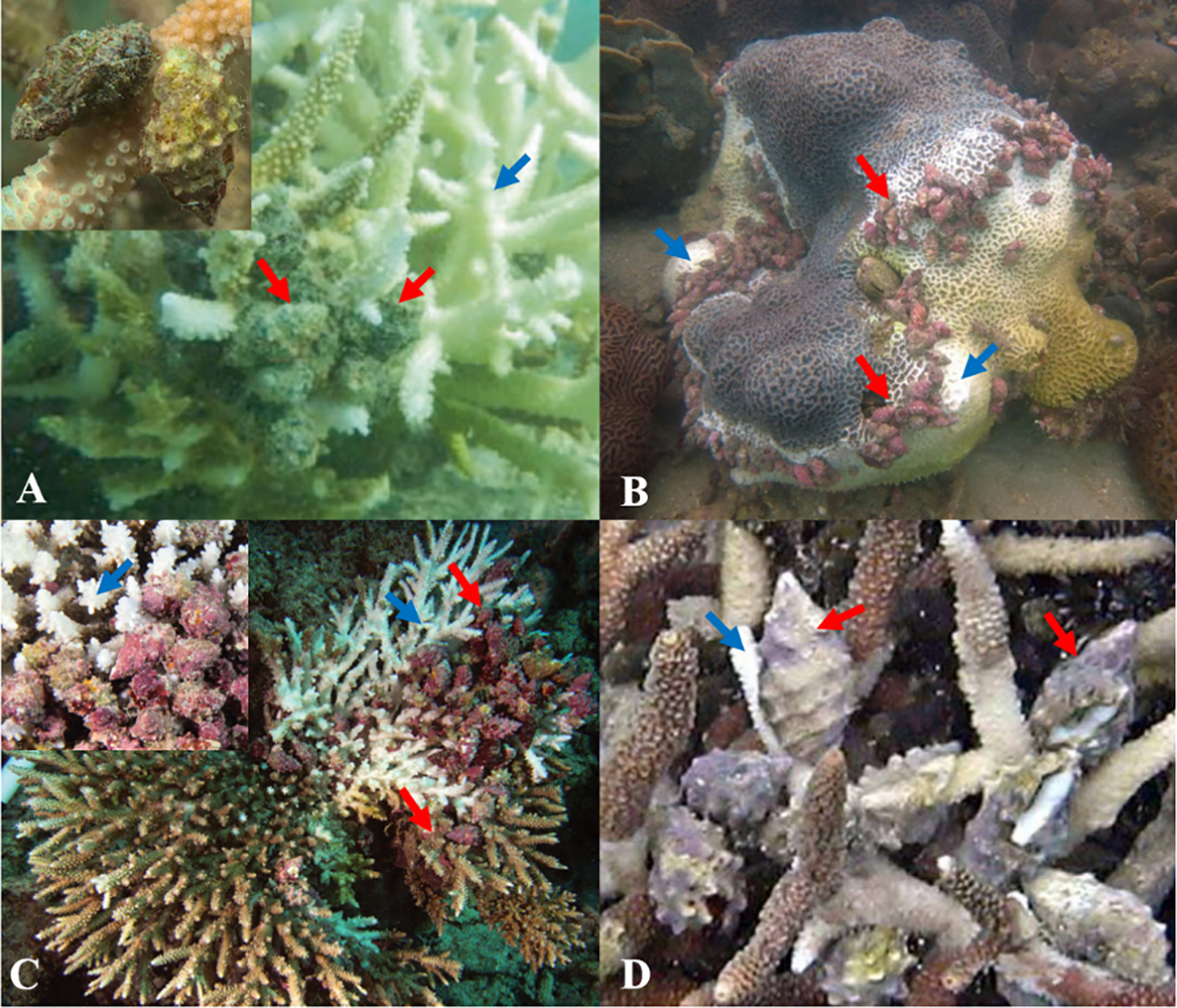
Drupella snails belong to the family Muricidae, within the phylum Mollusca. Despite their small size, ranging from 6.4 to 36 mm, when present in high densities they can severely reduce reef coverage, as documented in the back reef areas of Ningaloo Reef in Western Australia, where they degraded over 75% of the ecosystem (Zhang et al., 2024). Additionally, their small size allows them to hide very well within the cracks of the reef or along the base of branching coral colonies, with a special preference for Acropora spp. This preference might be linked to the fast growing traits of Acropora spp., which lead to easy damage and breakage (Zhang et al., 2024). This, in turn, increases the stress response of mucus production by the coral colony, attracting these predators whose strategic feeding techniques target damaged tissue.

Reproduction and early life history
Drupella snails reach sexual maturity at approximately 2.5 years and have an estimated lifespan of 7–8 years. They reproduce by laying kidney shaped egg capsules directly onto dead coral skeletons. After hatching, they slowly develop into free swimming larvae before metamorphosing into crawling juveniles. However, much remains unknown about these early life stages of Drupella snails.
Spawning occurs throughout the year, but generally peaks during summer: around June and December for the Northern and Southern Hemispheres, respectively. Furthermore, water temperature influences spawning and embryonic development, with lower temperatures suppressing reproduction and higher temperatures accelerating development. Reproductive output also varies between species, ranging from 67 egg capsules in D. rugosa to almost 600 in D. cornus as reviewed by Zhang et al. (2024).
Juveniles and adults may also occupy different habitats. Juveniles have been observed clustering among Acropora coral rubble in shallow reef environments, while adults are more commonly found on reef flats and slopes.
Drupella outbreaks
Drupella outbreaks occur worldwide, with some aggregations reaching millions of individuals (Haslam et al., 2025). They appear to be associated with declining coral reef health and environmental disturbances, such as nutrient input, and particularly mass coral bleaching events. The loss of live coral and subsequent degradation of reef habitats may create conditions that favour Drupella population increases. As coral health deteriorates, so do their resistance and immunity, making them more prone to outbreaks, although the exact mechanisms remain poorly understood. This relationship was observed on Koh Tao, where a large scale bleaching event in 2010 was followed by a significant Drupella outbreak in 2011 (Hoeksema et al., 2013). Similar patterns have been documented in the Maldives and Mauritius, where outbreaks followed extensive coral loss and declining reef health (). Climate change, seasonal variations, and interactions with other coral predators, such as Crown of Thorns Starfish (COTS), may also contribute to outbreak dynamics.
Crown of Thorns Starfish
Overview
Unlike Drupella spp., Acanthaster planci—commonly known as Crown of Thorns Starfish (COTS)—is a much larger predator belonging to the family Acanthasteridae. This multi armed predator has 10–20 arms, can grow up to 1 metre in diameter, and has an entire body covered in venomous spines. This predator has been a major cause of coral cover loss along the Great Barrier Reef, with populations outbreaking approximately every 15 years (Fabricius et al.,2010). Just like other starfish species, COTS feed by extruding their stomachs out of their bodies to digest coral tissue, leaving a trail of exposed white skeleton in their wake.
Under normal conditions, COTS occur at relatively low densities (approximately 0–1 individuals per hectare). During outbreaks, densities can increase to more than 10–1,000 individuals per hectare. In as little as one year, an adult COTS is estimated to feed on about 12 m² of coral tissue, in comparison to other corallivorous starfish which typically feed on up to 1.9 m² per year (Deaker and Byrne, 2022). This is not only driven by their large body size, but also by their rapid growth, reproduction, and consumption rates, making them the most feared predators among coral colonies.
Reproduction and early life history
Interestingly, in their early life stages, COTS are primarily herbivores, before transitioning to a corallivorous diet as they reach their adult stage. With a lifespan of 5–9 years, adult COTS reach sexual maturity at around 2 years of age, at which point they are roughly 20 cm in diameter, continuing to grow for a couple more years (Deaker and Byrne, 2022) . Despite this, COTS have been noted to shrink in size when starved and are able to survive several months without feeding, which makes it difficult to accurately age them (Deaker et al., 2020). Similar to Drupella spawning, COTS reproduction involves synchronous spawning during the summer season, when an individual female can release up to 100 million eggs into the water column, where they are fertilised by sperm released simultaneously by nearby males. These sheer quantities make them rather successful even at low population densities (Babcock et al., 2016), which is further enhanced by the durability of the larval stage; larvae can remain planktonic for up to three weeks, allowing them to disperse between reefs via ocean currents.

COTS outbreaks
Research suggests that outbreaks are not caused by a single factor, but rather by a combination of environmental conditions, human activities, and the species’ own biological characteristics. These outbreaks have been recorded across the Indo-Pacific, particularly in the Great Barrier Reef, where they represent one of the major causes of coral loss alongside coral bleaching and cyclones.
Outbreaks are generally associated with a combination of environmental and human induced factors. Two of the main hypotheses are increased nutrient availability and the reduction of natural predators. Nutrient enrichment—often resulting from agricultural runoff, sewage, and coastal development—can increase phytoplankton availability and potentially improve larval survival. Meanwhile, overfishing may reduce populations of natural COTS predators, allowing more individuals to survive. However, neither hypothesis alone sufficiently explains all outbreaks, and their relative importance appears to vary between locations.
Once an outbreak develops, high COTS densities can lead to substantial reductions in live coral cover. Their feeding activity can cause extensive reef degradation, reducing structural complexity and affecting associated fish and invertebrate communities. Outbreaks can also spread between neighbouring reefs through larval dispersal, resulting in successive waves of coral mortality across larger reef systems.
What does this mean for conservation?
Both Drupella and COTS outbreaks represent significant challenges for coral reef conservation, as they can cause extensive coral mortality and contribute to the degradation of reef ecosystems. Although both are natural coral predators, unusually high population densities can shift their ecological role from normal grazing to a major source of coral loss. Drupella outbreaks are particularly concerning because these snails often aggregate on branching corals potentially causing localised but severe damage to coral colonies. Similarly, COTS outbreaks can result in extensive reductions in live coral cover across much larger reef areas. These losses reduce reef structural complexity, affect associated biodiversity, and compromise the ability of reefs to recover from other disturbances. Consequently, both outbreaks should be considered in broader coral reef monitoring and conservation strategies.
For conservation, managing Drupella outbreaks requires both direct intervention and efforts to improve overall reef health. Zhang et al. (2023) identify manual removal as the most direct and effective short term method for reducing snail densities, particularly in areas where aggregations are causing significant coral damage. However, they also emphasise the importance of marine protected areas, maintaining natural predator populations, and reducing environmental pressures that may contribute to outbreaks. An important limitation is the lack of research into early outbreak detection and long-term ecological consequences, highlighting the need for more consistent monitoring of Drupella populations and their effects on coral communities. Similarly, COTS management requires a combination of approaches rather than focusing on a single potential cause. Babcock et al. (2016) recommend integrated monitoring of nutrient inputs, fishing pressure, and relevant predator populations, alongside management strategies that reduce nutrient pollution and protect reef food webs. More recently, Matthews et al. (2024) demonstrated that targeted and sustained COTS culling can significantly reduce coral losses and help protect reef recovery. Together, these findings highlight the importance of early detection, long-term monitoring, and active population management as part of wider conservation strategies aimed at maintaining coral reef resilience.
Reference list: