

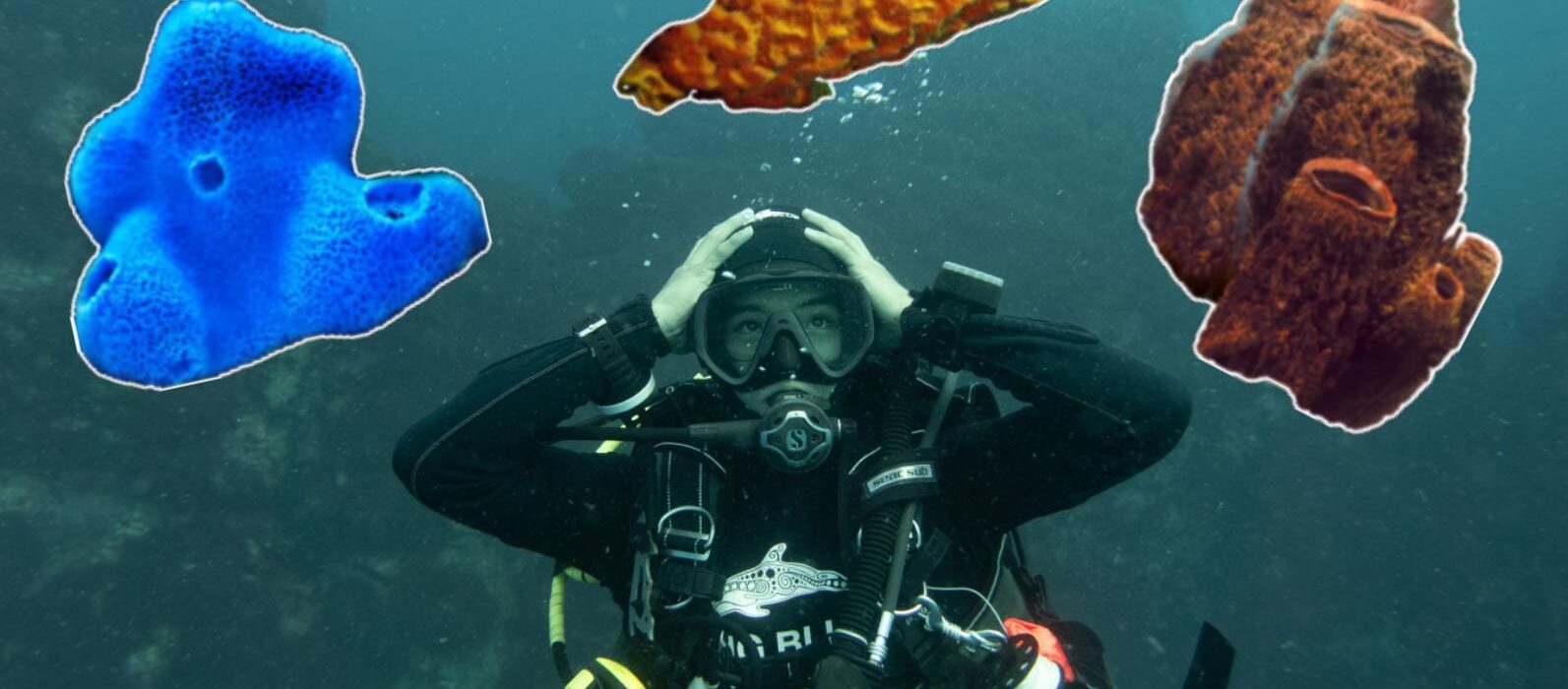
What are Sponges?
Sponges of the Phylum Porifora are found globally in every ocean and every environment. From the warm tropical waters of the equator to the freezing waters of the polar regions. They are even found in deep, dark ocean trenches… sponges are everywhere!

Here in Koh Tao, sponges play an integral part in determining reef health; both too little and too much may signal a reef in distress, but just the right amount means the reef is functioning healthily.
Sponges actually predate coral by around 100-200 million years, actually first showing up in fossil records around 650 million years ago. Meaning that they are one of the very first animals to exist, sitting right at the base of the tree of life. Due to this ,sponges have had 150 times longer than humans to adapt, evolve and settle into their desired environment.
Sponge Structure
As sponges are simple invertebrates, meaning they lack a spine as well as complex tissue structures like us, and instead have a plethora of specialized cells and structures to function. Sponges are mainly comprised of a dense matrix of the collagen protein called “Spongin” as well as silica (calcium carbonate in the case of Calcarea), based needle like structures called Spicules, which make up a kind of skeletal structure giving the sponge its rigid shape.
This structure is enveloped in a layer of living cells, which are split into 3 groups; Pinacocytes, skin cells that are packed together on the Pinacoderm or the “outer layer”; Choanocytes, specialized cells that use their flagella to pump water through the structure as well as capturing nutrients and planktonic organisms; and finally the most interesting cells making up the sponge: the Amoebocytes, mobile cells, much like white blood cells, that can move through the sponges mesophyll to repair damaged sections, distribute nutrients, and produce spicules.
Sponge function
All these structures come together to perform one primary function: pump and filter water… and they do it well!
A combined effort of the choanocytes pumping water through the porous surface into the main column allows a single kilogram of healthy sponge to filter up to 1000 litres every single hour. That’s 24000 litres every single day. As such, sponges are much more efficient at turning poor-quality water back into “clean” water when compared to other filter feeders. As corals flourish in cleaner waters, sponges evidently play a big role in their health.
Sponges also play a critical role in the recycling of nutrients in the water column. Sponges can take in dissolved organic matter from the reef leaks, which is otherwise inaccessible to other organisms, and turn it into physical detritus and matter that organisms like crustations or annelids can feed upon. The last main function of sponges is to act as a sort of glue, often sticking coral down to the reef to prevent wave action from moving it. These overall improves reef structure and stability.
Koh Tao Natives
Koh Tao is home to a variety of different sponges found at every single dive site.
The most recognisable of course being the “Giant Barrel Sponge (Xestospongia testudinaria). Often seen protruding out of the reef, these large brown volcano shaped sponges are the largest sponges found on Koh Tao. Some sponges can easily grow over a metre high and wide, especially at some of the deeper dive sites. Usually, they can be found covered in a writhing ball of medusa worms that benefit from the filtering effects.
The next 3 are commonly found sprawling across rocks and sometimes even encrusting over coral skeletons. Blue Soft Sponges (Haliclona spp), Purple Encrusting Sponge (Pseudoceratina purpurea), and Orange Sprawling Sponge (Clathria reinwardti). Amazing to see underwater, often bringing a bit of colour to some of the newer artificial sites. However, these must be monitored in moderation as they are able to compete with many coral species, often enveloping them, which leads to the coral’s death.
So next time you go diving, don’t be a fun sponge and keep an eye out for these amazing animals and thank them for keeping the reefs looking beautiful. Living prehistoric beings.
Author: Arthur Cronin
Former Eco intern