


Marine turtles are truly captivating creatures, their gentle demeanor and dashing good looks have propelled them to the forefront of conservation and research acting as a flagship species for marine conservation efforts for decades. It is no wonder they have their own World Turtle Day!
Key phrase: In conservation biology, a flagship species typically is a charismatic vertebrate species selected for its appearance and value to the public to become the face of a conservation campaign. Using these charismatic animals to trigger emotive responses in the public has proved a very effective method of raising funds for wider conservation efforts.
May 24th is World Turtle Day, a day where we celebrate and treasure this awesome group of marine species.
There are seven species of marine turtle, ranging from the colossal leatherback Dermochelys coriacea which can sometimes weigh as much as 700kg (!?) to the cute little hawksbill Eretmochelys imbricata typically measuring less than one meter in length. Advances in biologging, stable isotope analysis, and the field of genomics have allowed the scientific community to gain a unique and powerful insight into the biology and ecology of each of these species, binding us ever closer to these charismatic creatures.
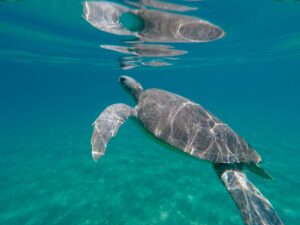
Despite their universal appeal to divers, snorkellers, and keen conservationists alike, as well as Crush’s iconic appearance in the Disney franchise Finding Nemo, general knowledge on our shelly friends is somewhat lacking within the ocean-exploring community. Here at Big Blue Conservation we just love World Turtle Day as it gives us an excuse to chat non-stop about marine turtles (one of Jade’s favourite subjects!)
This is what brings us to the topic of nesting, a fascinating part of the life cycle of marine turtles.
When people find out marine turtles make nests, the imagination can’t help but wander to images of them wandering the beach, looking for twigs and bits of foliage to construct a safe space for their eggs… but this isn’t really what we mean when we say ‘nest’. Turtles are marine reptiles so of course, they have eggs, but when you stop to think about it – a marine creature venturing onto land to dig a nest and lay a clutch certainly is a strange phenomenon. And when you see it happening, it seems even stranger.
A shiny wet turtle emerges from the surf, in a less than elegant manner. Immediately the prehistoric-sounding grumbles, huffs, and puffs begin. Marine turtles are heavy beasts, as soon as they are out of the water, the weight of their carapace begins to press down on their organs and lungs, which can’t be a nice feeling. Then commences the monumental task of hauling their colossal weight up the beach.
Now, what is a body pit? Simply put, it is a pit a turtle digs around her body. Turtles dig these pits by flapping their fore flippers back and forth to shift the sand around them. These pits can be huge, and when left abandoned on the beach with no nest within, they are particularly helpful to marine biologists who need to find a hiding spot to make their observations on the gentle giant without disturbing the process.
In some cases, these body-pits can take hours to construct, and often a turtle cannot determine if the space selected has optimal conditions for nesting until partway through the process, at which point she would need to abandon the pit and start all over again in a new location. Often this can be triggered if the turtle hits bedrock, litter, and debris or seawater.
Green turtles (Chelonia mydas) have been observed to dig up to six body pits in one nesting attempt, and as you can imagine this makes deciphering turtle tracks in the light of day an absolute nightmare for all those turtle biologists out there. Once the body pit is complete, and the nesting female is happy with her spot she moves onto the next stage in the process: the egg chamber. Again, this is essentially what it says on the tin: a chamber a turtle digs in which to lay her eggs. Now, this is where it gets pretty awesome.
Have you ever tried to dig a 30cm across, 70cm deep, perfectly cylindrical hole on a sandy beach? If you have, you know it’s exceedingly difficult. However, it is important to bear in mind humans have not evolved to dig perfectly cylindrical holes in the sand, and marine turtles have.

The turtles use their back flippers this time, like big, webbed hands. Alternating flippers each time, they reach into the sand, scoop up a little flipper-full and flick it aside. As the hole gets deeper and deeper, they reach further and further into the hole and keep scooping out little mounds of sand until the hole is anything between 50-80cm deep for green turtle nests, whereas the leatherback has been recorded to deep egg chambers as deep as 100cm and more!
When the female is satisfied with her work, she will deposit her eggs into the camber, carefully cover the eggs with an aerated layer of sand (to protect the eggs but also allow them to respire!), and then camouflage the whole nest with a big mound of sand. Now the process is complete, she’ll never see those eggs again. Turtles are an r-selected species, meaning that their reproductive strategy is to have as many offspring as possible and provide no parental care after hatching.
Forty to seventy days later, hundreds of turtle hatchlings will emerge from the nest, triggered by the hatching of their neighbors, and dash to the water where their biggest adventure begins, solo.
Marine turtles face seemingly insurmountable challenges from day dot from climate change threatening their incubation as embryos, to poaching, bycatch, entanglement, plastic ingestion, and urbanization of their habitats. Their complex life cycles, longevity, and reproductive strategy mean they need our help more than ever.
How can you offer support on World Turtle Day?
Financial aid to organizations working on the front line of research and conservation is a great way to start. The work of the Society for the Protection of Turtles based in North Cyprus is essential for the preservation of turtle populations, and the research they do is uncovering new insights into turtle biology and ecology each year. Their work relies on donations, all of which go directly to turtle conservation and research. Don’t have much cash to spare? Do your bit by curbing the effects of climate change, reducing your plastic consumption, and selecting sustainable seafood to put on your dinner table.